
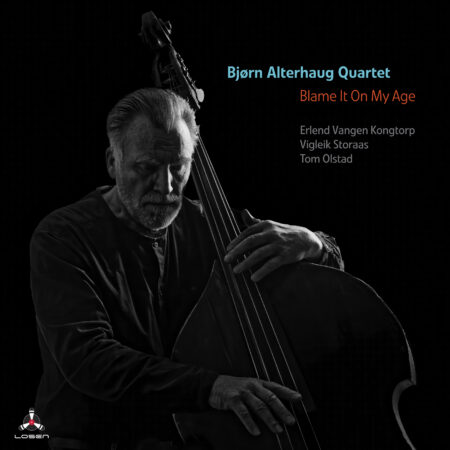
Artists
Erlend Vangen Kongtorp tenor saxophone
Vigleik Storaas piano
Bjørn Alterhaug bass
Tom Olstad drums
CD info
Catalogue No: LOS 329-2
EAN: 7090025833298
1 Sogno Misterioso (Bjørn Alterhaug) 9:00
2 Blame it on my youth (Oscar Levant) 5:08
3 Stev (Vigleik Storaas) 5:09
4 Friends (Bjørn Johansen) 7:01
5 Egeli (Bjørn Alterhaug) 3:22
6 Oleo var. 1 (Sonny Rollins) 3:24
7 Easy Living (Ralph Rainger) 5:24
8 Drum Bird (Bjørn Alterhaug) 5:38
9 Peace (Horace Silver) 5:47
10 Oleo var. 2 (Sonny Rollins) 3:40
Recorded October 6, 2025 by Jo Ranheim at Øra Studio, Trondheim, Norway
Mixed and mastered November 2025 by
Celio Barros at Klarlyd Studio, Haltdalen, Trøndelag, Norway
Produced by Bjørn Alterhaug
Executive producer Odd Gjelsnes
Cover photo by Stein Grebstad
Design by Max Franosch
Digisleeve in the link below:
Download Press Release (PDF)
Kjøp plater direkte fra Losen Records. Kr 200,- per CD inkl. porto. Vipps til 99006190 og mail navn og adresse til odd@losenrecords.no
The Bjørn Alterhaug Quartet – featuring Erlend Vangen Kongtorp on tenor saxophone, Vigleik Storaas on piano, Tom
Olstad on drums, and Bjørn Alterhaug on double bass – was formed two years ago.
This recording grew out of a four-day tour organized by the Mid-Norwegian Jazz Center. The approach was inspired by
classic LPs from the 1950s–70s, when sessions often took place in a single day. Our studio session lasted about six hours – essentially a musical experiment. “Blame It On My Youth” was one of the pieces recorded at Øra
Studio in Trondheim on October 6, 2025. Based on that studio experience and the more private reflections of an 80-year-old, I chose the album title “Blame It on My Age.” At my age, it’s not unusual to think about one’s own physical changes over time. The answer is often clear: everything moves more slowly than before. Shakespeare expressed this inevitable change beautifully: “Old age crept up on me; one day I found myself in its clutches. It carried me to another land, where I was no longer the same.”
Unexpected thoughts have crossed my mind – even giving up playing altogether. Especially after the stroke in 2017, when my index and middle fingers simply refused to obey the musical “commands” from my brain. A long and laborious process began to get my fingers and brain to play together again.
Supportive musicians helped me through a tough period of doubt and uncertainty about whether I could continue playing bass. After five or six years, I felt I had reached a musical level that seemed acceptable to me – and, according to my fellow players, was not a hindrance to them. That felt good.
The sound of deep bass tones has been a passion – perhaps even an obsession – ever since I strummed my older brother’s double bass at the age of eight or nine. This curiosity was tied to exploring the sensual, aesthetic, and existential aspects of music making. Of course, always together with others: creating in the moment, in real time,
which brings joy, insight, learning, and knowledge – not only about music, but about how human interaction unfolds when concentration and collaboration work. I believe passion and motivation can even be healthy, bridging age differences in real-time interaction.
Not least with my fellow players on this album: Erlend (28), Vigleik (63), and Tom (72). The quartet spans generations in a way that is truly special. Here lies the opportunity for our stories and experiences from different times and places to meet, collide, and create something unexpected.
Our music – jazz – is rooted in a long and diverse tradition, one that is never static but always in motion. Passing it on in a generous and creative way, so that the best in each individual can be brought out through interaction, is one of the most important aspects of this art form. Jazz also shares many parallels with life itself: education, politics, social development – where presence, attentiveness, and give-and-take for the common good are essential. In short, it is a participatory and democratic art form. With such existential and human qualities, I believe jazz deserves far greater attention and recognition in today’s world than it currently receives.
Finally, one important person must be mentioned; Celio Barros from Sao Paulo, now running “Klarlyd Studio” in Haltdalen, Trøndelag. His post-production, mixing, creative input, and good humour has been invaluable. Thank you, Celio!
SOGNO MISTERIOSO A composition born from a dream and completed immediately. For me,
this was a rather unusual way of creating music – hence the title.
BLAME IT ON MY YOUTH A jazz ballad from 1932, frequently performed by many jazz musicians,
including Chet Baker and Keith Jarrett. It was composed by Oscar Levant, an American jazz
pianist and actor with strong classical influences.
STEV Vigleik writes: “The title of the song is coincidental – one of the letters in the original title
was misread. ‘Stev’ turned out to be a much better title anyway, even though the music has
little connection to Norwegian folk traditions.”
FRIENDS In 1980, the saxophonist Bjørn Johansen composed the ballad “Friends” for his
close friend Egil Kapstad. The quartet consisted of Ole Jacob Hansen, Bjørn Alterhaug, Bjørn
Johansen, and Egil Omar Kapstad. The album Friends was recorded and released in 1980.
Upon its release, the album received excellent reviews in newspapers across the country,
and in 2007 it was ranked by Ballade.no as one of the 20 best and most significant jazz records
in Norway.
EGELI This piece was written four days before pianist Egil Kapstad passed away in July 2017.
Egil was gravely ill with cancer, but he was able to hear the composition performed at his
home in Kristiansand by the composer on piano, together with saxophonist John Pål Inderberg.
“Egeli” is a Norwegian anagram of the Greek word “elegy”, meaning lamentation.
OLEO var. 1 This was an experiment in the studio based on the well-known composition “Oleo”.
Miles Davis is said to have remarked about the 1954 recording with Sonny Rollins: “A melody
he wrote was ‘Oleo’. He got the title from Oleomargarine, a cheap butter substitute.” In our
version, the piano and drums were instructed to start completely freely – yet within Oleo’s
AABA form – while the others joined in later. This is how it turned out, with a little editing.
EASY LIVING A famous jazz ballad from 1937, known through interpretations by Billie Holiday
and Ella Fitzgerald. The tune was suggested in the studio by Erlend and recorded on the spot.
DRUM BIRD Written in 1995 for drummer Jon Christensen, during the period when we had a
trio with Bobo Stenson, Jon, and myself.
PEACE Horace Silver came from Cape Verde, West Africa. This beautiful ballad (1959) has often
served in my bands as a short 10-bar meditation among other up-tempo compositions. In our
two-part version, we wanted to approach it differently: no rehearsal – straight into the first
part with powerfully aggressive drumming and saxophone playing. The second part offers a
meditative, calm contrast, mixed afterward. Together, the two parts might evoke associations
with the troubled world we live in.
OLEO var. 2 This final track continues the studio experimentation. It resembles Variation 1 but
introduces many nuances and sections that offer intriguing perspectives on what improvisation
– the unexpected – can bring in terms of new musical discoveries and learning.